|
|
|
|
|
|
|
|
|
|
Industrial, High Quality Saw Blades |
|
|
|
|
Our
blades are made from the highest quality tool steels and
carbides. Using premium quality tool steels and C-4 though
C-11 super micro-sheen sub-micron carbide, the cutting performance
or our saw blades are second to none. With 3 regional warehouses
stocking over 90,000 blades, we are sure to be able to meet
your needs and time requirements all at a competitive price.
Call us for your custom saw blade requirements with fast
turn around times.
|
|
|
|
|
|
|
|
|
|
|
|
|
|
|
|
|
|
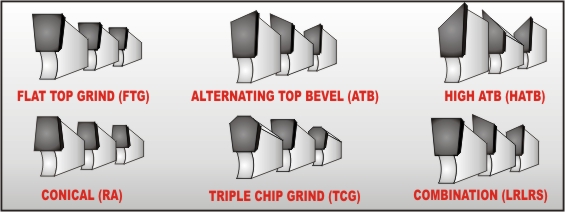
(FTG)
FLAT
TOP GRIND
flat
top teeth are generally used on ripsaw blades. They work great
for hard and soft woods and are a very efficient a removing
wood quickly. Less emphasis is placed on chipping and splintering
because these are reduced when ripping with the grain. Flat
top teeth can also be used with other tooth designs to "rake"
material out of the cut. |
|
(ATB) ALTERNATING
TOP BEVEL
this tooth design means that the carbide alternates between
a right and left hand bevel. Also corresponding tooth face
shears can be added to varying degrees to provide a knife
like edge on the high cutting side. These blades are great
for cross-cutting solid woods and veneered plywoods. Higher
tooth counts can provide for a finer cut. Also this design
can be used on rip saw blades because it helps the blade to
not follow the grain of the wood. |
|
(TCG)
TRIPLE CHIP GRIND
this is a great blade for cutting really hard materials like
MDF, plastics, laminates and non-ferrous metals. These are
high production blades and will keep their edge longer than
ATB with almost as good cut quality. |
|
(LRLRS)
COMBINATION
This is kind of a generic term and can have many applications.
L=left, R=Right, S=Straight, Raker. This tooth design can
be used on combination Rip and Crosscutt blades by adding
an enlarged gullet after the Raker tip or can be used on precision
trim saws with enhanced face shears and top bevels for extremely
smooth chip-free multi-use cutting. |
|
(HATB)
HIGH ALTERNATING TOP BEVEL
like the name implies this design is similar to the ATB except
the bevels are increased and enhanced. This design can provide
extra fine crosscutting and excel at cutting materials that
are prone to chipping. The extreme knife like cutting edge
is the perfect blade for slicing through melamine with a super
clean edge. |
|
(RA
) CONICAL
Conic scoring blades are designed to work in comination with
our panel saw blades. By adjusting the depth of the score,
the width of the cut can be adjusted to just slightly wider
than the main panel sawblade. This combination is commonly
used on double sided melamine and veneered plywoods that chip
or fur easily. |
|
|
|
|
|
|
|
| Saw
Blade Application Categories |
|
|
|
|
|
|
|
|
|
|
|
|
|
|
|
|
|
|
|
|
|
|
|
|
|
|
|
|
|
Ready
To Ship, With A Complete Line Of :
Industrial Quality Carbide Blades
|
|